
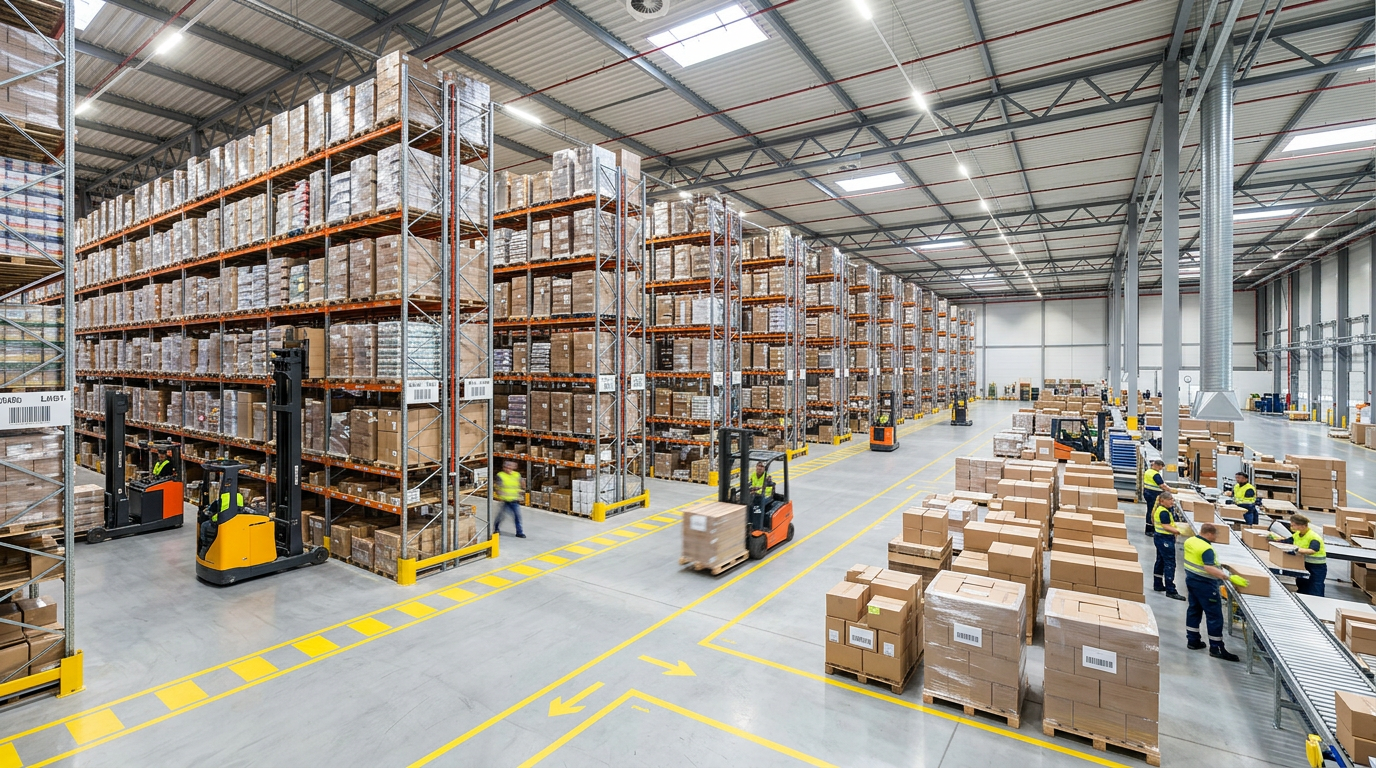
In fast-paced commercial centers across Egypt, Saudi Arabia, and the wider Gulf, distribution speed is no longer just a competitive advantage—it is a baseline customer expectation. Whether dealing with food and beverage, consumer electronics, pharmaceuticals, or industrial spare parts, businesses that handle fast-moving goods face relentless pressure to fulfill orders accurately and dispatch them within tight delivery windows.
Yet, many warehouses across the region still suffer from systemic layout inefficiencies, uncoordinated storage methods, and manual picking routines. When pickers spend more than half their shift walking through sprawling aisles or searching for misplaced pallets, order fulfillment times stall and operational costs climb. Transforming your warehouse from a passive storage shed into an active, high-velocity distribution hub requires structured bin management, data-backed layout planning, and integrated operational technology.
The Hidden Costs of Unoptimized Warehouse Floor Plans
A poorly structured warehouse affects virtually every department in an enterprise, from sales and customer service to accounting and logistics. When inventory is scattered arbitrarily, operational friction manifests in several damaging ways:
- Excessive Travel Time: In unorganized facilities, warehouse pickers can spend up to 60% of their time simply traversing aisles rather than picking items. This dramatically reduces daily order capacity.
- High Order Error Rates: Without distinct, systematically labeled bin locations, pickers often confuse products with similar packaging or size variants, leading to costly returns and dissatisfied B2B or retail clients.
- Inventory Spoilage and Dead Stock: For perishable goods or items with strict shelf-life requirements, poor layout design obstructs First-In, First-Out (FIFO) or First-Expired, First-Out (FEFO) picking, resulting in write-offs and direct financial loss.
- Bottlenecks at Staging and Inbound Docks: When cross-docking and receiving areas are congested, incoming shipments sit unprocessed while downstream sales orders are held up due to apparent stockouts.
Core Principles for Designing a High-Velocity Warehouse Layout
Modern warehouse design revolves around continuous velocity rather than static maximum capacity. When planning or reorganizing your facility, consider these core structural principles:
1. Establish Dedicated, Unidirectional Material Flow
To eliminate internal congestion, ensure goods move through your facility in a structured, unidirectional loop—frequently modeled as a "U-shaped" or "straight-through" flow. Receiving docks, inspection zones, storage racks, picking lanes, packing tables, and outbound staging must follow a logical sequence. Heavy forklift traffic should never cross paths with manual picking personnel whenever possible.
2. Implement ABC Analysis for Dynamic SKU Placement
Every fast-moving warehouse should classify inventory based on turnover velocity and pick frequency using ABC analysis:
- Class A (High Velocity): Typically represents 10%–20% of your total SKU count but accounts for 70%–80% of your total order movement. These items must be situated as close as possible to packing and staging areas, at ergonomic waist-to-shoulder rack heights ("the golden zone").
- Class B (Moderate Velocity): Represents roughly 30% of inventory and accounts for 15%–20% of movement. Position these in secondary aisles immediately behind Class A zones.
- Class C (Slow Moving): Comprises 50% or more of your catalog but generates less than 10% of picking volume. Store these in higher rack levels, deeper aisles, or mezzanine storage areas where pick travel times will not impede routine workflows.
Mastering Multi-Tier Bin Management and Location Coding
A warehouse layout is only as effective as the bin-level precision that directs your staff. Treating an aisle or an entire rack shelf as a single storage bucket inevitably produces inventory discrepancies and delays.
Developing an Intuitive Location Hierarchy
Every cubic foot of storage space should have a distinct, human-readable, and machine-scannable coordinate. A standard best-practice naming convention follows a structured hierarchy:
Zone > Aisle > Rack/Bay > Shelf Level > Bin Position
For example, a location code formatted as Z1-A04-B12-L2-P03 immediately directs a warehouse handler to Zone 1, Aisle 4, Bay 12, Level 2 (eye-level), Position 3. By standardizing these coordinates across all regional branches, companies make onboarding new warehouse labor significantly faster and minimize picking confusion.
Dynamic vs. Fixed Bin Allocation
Fast-moving operations often struggle between fixed binning (assigning each item a permanent home) and dynamic/chaotic binning (assigning items to whatever compliant bin is empty). In practice, regional distributors achieve the best results with a hybrid strategy:
- Fixed Pick Faces: Fast-moving Class A items are assigned dedicated forward picking locations that are sized to hold one or two days' worth of demand.
- Dynamic Overstock/Reserve Bins: Bulk overstock pallets are placed dynamically in upper rack tiers based on cube utilization and weight restrictions. When forward pick faces drop below safe replenishment thresholds, stock is automatically directed down from reserve bins.
Integrating Warehouse Operations with a Central Cloud ERP
A physical warehouse blueprint cannot deliver consistent speed without real-time inventory visibility. Standalone spreadsheets, manual clipboards, or disconnected local stock trackers inevitably create data silos between the warehouse floor, procurement, and commercial sales teams.
Modern enterprises eliminate this gap by coordinating warehouse routines through a centralized business management platform. When warehouse management operates in direct alignment with your broader ERP system, operational benefits multiply:
- Real-Time Stock Availability: Sales reps and branch managers can view exact on-hand balances across forward pick bins and reserve racks without requesting manual floor counts.
- Automated Replenishment Triggers: Procurement and inventory controllers receive automatic alerts when picking bins fall below defined minimum levels, preventing stockouts during peak shifts.
- Optimized Pick Lists: The system automatically sequences pick orders to create the shortest physical walking path through aisles, grouping multiple orders for wave or batch picking.
- Audit Trails and Discrepancy Tracking: Discrepancies identified during cycle counting are instantly reconciled against accounting ledgers, keeping financial valuations aligned with physical stock.
Step-by-Step Implementation: Modernizing Your Warehouse Operations
Transitioning to an optimized layout does not always require purchasing new land or overhauling your entire racking infrastructure. Managers can execute an operational upgrade in phased stages:
Step 1: Audit Physical Footprint and Turnover Metrics
Begin by mapping your existing facility, measuring usable clear heights, and analyzing SKU movement data over the previous 6 to 12 months. Identify seasonal spikes and categorize your active catalog using the ABC framework.
Step 2: Redefine Zones and Refresh Labeling
Clear out dead stock and congested staging areas. Re-label racks, shelves, and floor locations with clear, high-contrast, durable barcode labels. Ensure aisle markers are visible from main thoroughfares to guide forklift operators and pickers quickly.
Step 3: Establish Continuous Cycle Counting
Replace disruptive annual wall-to-wall physical inventory counts with rolling cycle counts. By counting a small selection of high-velocity bins daily or weekly, teams catch shrinkage and placement errors long before they derail order fulfillment.
Unify Your Supply Chain with ORG ERP
Achieving fast, error-free fulfillment requires tight synchronization between inventory, sales, purchasing, and finance. ORG ERP provides a comprehensive, cloud-based ERP solution tailored for businesses operating across Egypt and the Arab region. By managing inventory tracking, multi-branch operations, procurement, sales orders, accounting, and financial reporting on a single unified platform, ORG ERP empowers your team to gain total control over stock movements and scale your distribution network with confidence. Explore how ORG ERP can streamline your business workflows today.



Comments (0)
No comments yet. Be the first!