
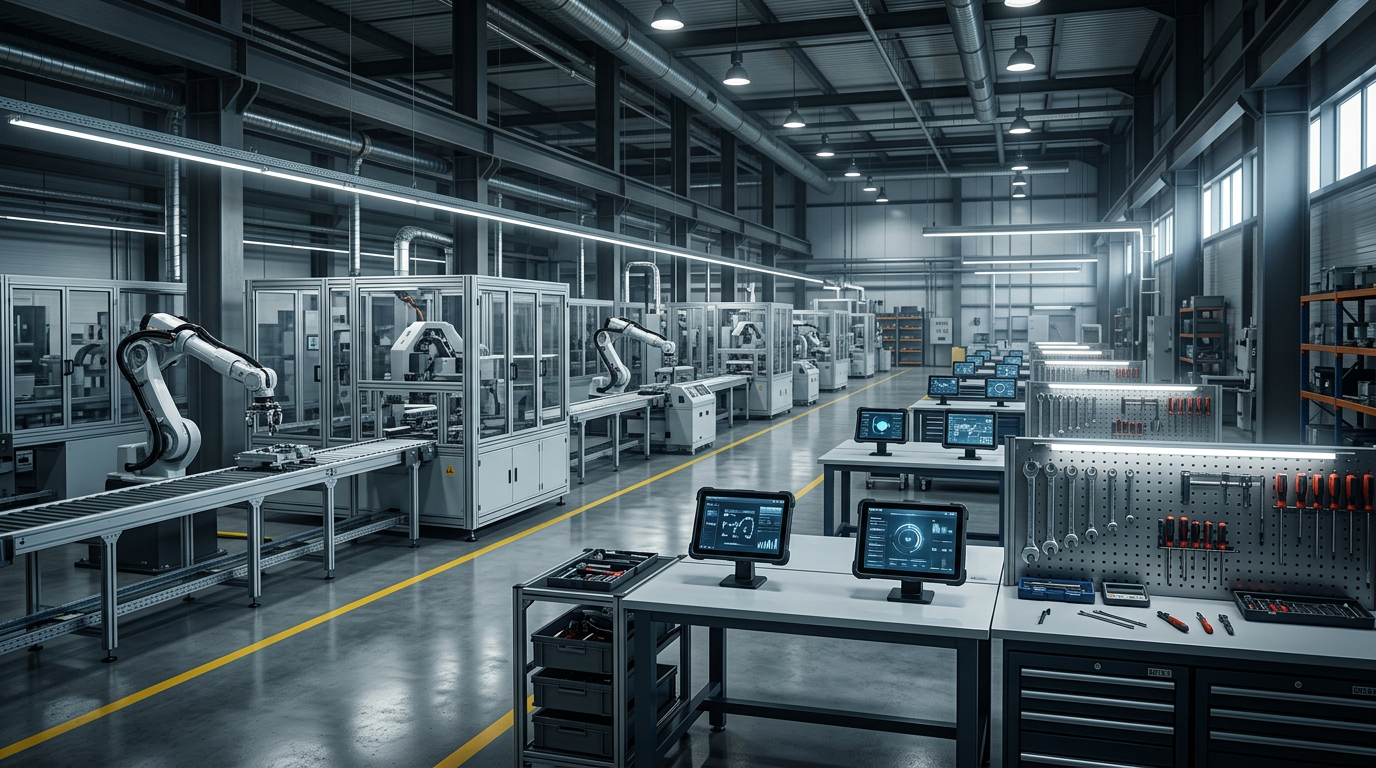
In capital-intensive industrial operations, profitability hinges on the continuous, dependable operation of machinery. Across manufacturing plants, processing facilities, and distribution hubs in Egypt and the wider Arab region, unexpected equipment breakdowns do more than stall assembly lines; they trigger ripple effects that inflate labor costs, deplete emergency spare parts budgets, cause missed fulfillment deadlines, and damage hard-earned client trust.
Historically, many facilities have relied on reactive maintenance—fixing equipment only after it fails. In today's competitive economic environment, where supply chains demand tight turnaround times and operating margins are closely guarded, this approach is unsustainable. Transitioning to a structured, data-driven maintenance strategy allows organizations to transform asset upkeep from an unpredictable expense into a driver of operational stability.
The True Cost of Unplanned Downtime
When measuring the impact of asset failure, business owners frequently look only at direct maintenance invoices: the cost of replacement components and emergency technician fees. In reality, the indirect costs often dwarf these figures:
- Idle Labor: Factory line workers and machine operators are unable to produce output while fixed payroll expenses continue to accumulate.
- Expedited Freight Premiums: Sourcing replacement components under emergency conditions frequently requires costly air freight and urgent supplier handling charges.
- Downstream Bottlenecks: When an upstream machine fails, subsequent stages—such as packaging, quality testing, and dispatch—grind to a halt, creating systemic operational paralysis.
- Contractual Penalties: Delayed customer shipments often result in direct financial penalties, discounted orders, or lost distribution contracts.
By moving from a reactive mindset to proactive asset management, maintenance managers can identify operational degradation before an outright failure occurs, preserving capital and stabilizing day-to-day operations.
Pillars of Proactive Maintenance Strategy
Modern plant managers typically balance three primary maintenance philosophies depending on the criticality, cost, and complexity of each asset:
1. Routine Preventive Maintenance (PM)
Preventive maintenance involves scheduled tasks executed at set calendar intervals or operational thresholds (such as run hours, cycle counts, or mileage). Examples include lubricating bearings every 500 operating hours or replacing air filters quarterly. Because it is scheduled in advance, preventive maintenance can be completed during non-peak hours or planned factory shutdowns, minimizing disruptions to daily output.
2. Condition-Based Maintenance
Condition monitoring relies on tracking equipment indicators—such as vibration analysis, thermal imaging, pressure levels, and oil condition—to determine whether an asset requires intervention. Technicians address issues based on measurable operational drift rather than arbitrary dates, ensuring components are replaced neither prematurely nor too late.
3. Run-to-Failure (Corrective) Maintenance
Run-to-failure is not an absence of strategy; it is a calculated decision for non-critical, low-cost assets where redundancy exists and replacement costs are negligible (for example, standard auxiliary light bulbs or non-essential backup pumps). For core production machinery, however, corrective maintenance must remain the rare exception.
Integrating Spare Parts Inventory with Maintenance Workflows
A frequent failure point in industrial plant maintenance is the disconnect between the maintenance workshop and the warehouse inventory department. It is not uncommon for technicians to diagnose an issue accurately, issue a work order, and then discover that the required seal, bearing, or electronic relay is out of stock.
"Effective asset maintenance relies as much on inventory visibility as it does on mechanical expertise. When spare parts management is siloed from maintenance scheduling, downtime extends exponentially."
To eliminate this friction, industrial enterprises must align spare parts replenishment with maintenance planning:
- Maintain Asset Bills of Materials (BOMs): Every major machine should have an explicit digital BOM listing its serviceable subcomponents, specifications, and manufacturer part numbers.
- Automate Reorder Thresholds: High-wear components must have automated minimum reorder points tied to procurement leads, preventing stockouts during routine overhauls.
- Track Component Usage Trends: Monitoring consumption rates highlights chronic mechanical issues. If a specific pump consumes impellers twice as fast as expected, the root cause may be improper fluid viscosity or mounting vibration rather than natural wear.
- Manage Vendor Lead Times: For imported machinery components common across regional plants, procurement timelines can stretch to weeks or months. Planning maintenance cycles around verified vendor lead times is vital to sustaining continuous operations.
Standardizing Digital Work Orders and Technician Tracking
Manual maintenance logs kept on clipboards or disparate spreadsheets compromise accountability and historical visibility. Transitioning to unified digital work orders ensures that every maintenance request follows a structured lifecycle:
- Incident Logging: Machine operators or floor supervisors log irregularities immediately via a digital interface, attaching descriptions and priority levels.
- Dispatch and Assignment: Maintenance managers assign work orders based on technician specializations (electrical, mechanical, pneumatic) and current workload.
- Execution and Documentation: Technicians record hours spent, components retrieved from inventory, and specific actions taken, providing full traceability.
- Sign-Off and Closure: Quality and safety inspectors review completed work before resetting the machine's operational status.
Over time, this digital log builds a comprehensive asset history. When management evaluates whether to overhaul an aging line or invest in a new facility expansion, accurate repair histories and cumulative cost data guide strategic decisions.
The Value of an Integrated Cloud ERP in Maintenance
Managing equipment reliability requires continuous coordination across multiple departments. Purchasing teams must source parts, warehouse staff must track storage locations, production managers must schedule downtime around client orders, and accounting departments must monitor capital expenditure and operating expenses.
A modern cloud ERP system connects these moving parts within a single source of truth. When maintenance workflows, inventory, purchasing, accounting, and HR operate in a unified system, scheduling a repair automatically reserves parts in the warehouse, calculates labor and component expenses into general ledger accounts, and alerts production supervisors of scheduled machine availability.
For growing enterprises seeking to modernize operational workflows, ORG ERP provides an integrated cloud platform covering finance, inventory, purchasing, manufacturing, HR, and sales, giving decision-makers complete visibility over assets and operations from any location.
Key Performance Metrics Every Maintenance Team Should Track
To continually refine maintenance effectiveness, leadership teams should establish objective key performance indicators (KPIs):
- Mean Time Between Failures (MTBF): Measures equipment reliability by tracking the average operational hours between unscheduled breakdowns. Increasing MTBF indicates that preventive routines are working.
- Mean Time to Repair (MTTR): Tracks the average time required to troubleshoot, repair, and recommission an asset after failure. Lower MTTR reflects efficient technician response and ready parts availability.
- Planned Maintenance Percentage (PMP): The proportion of maintenance hours spent on scheduled preventive tasks versus reactive emergencies. High-performing facilities typically aim for 80% or more planned work.
- Overall Equipment Effectiveness (OEE): A composite metric evaluating availability, performance speed, and quality output to reflect the true productivity of key production lines.
Conclusion: Building Long-Term Asset Resilience
In modern industrial and commercial facilities, machine health directly dictates financial health. Moving away from reactive fire-fighting toward systematic preventive care, transparent spare parts inventory, and standardized work order tracking preserves machinery lifecycles and safeguards production commitments.
By unifying asset operations with procurement and financial tracking, businesses across the Arab region can build lean, resilient production ecosystems capable of meeting market demand consistently and profitably.
To learn how a modern cloud ERP can streamline your business workflows, visit ORG ERP and explore tailored solutions for your operational growth.



Comments (0)
No comments yet. Be the first!